
Dubai Fitness Report 2026: Key Stats & What They Mean
94% of UAE residents aspire to be healthier. Only 65% improved. Here's what Dubai's fitness data in 2026 actually says - and what it means.

Why the numbers matter — and what they actually show
Dubai has a fitness story that looks impressive from a distance and becomes more complicated the closer you get. The Dubai Fitness Challenge reached 3 million participants in 2025. New gyms and wellness studios continue to open across the city. The government's National Sports Strategy 2031 positions the UAE as a global leader in health and fitness. The headlines are consistently positive.
The data underneath those headlines tells a more nuanced story — one about the gap between aspiration and behaviour, the barriers that real residents face, and the specific ways in which Dubai's fitness culture is genuinely changing rather than just growing. For Hey Trainer, working with over 5,000 active members across Dubai, that nuance is visible in what people book, when they cancel, which formats they return to, and which ones they abandon.
This report combines Hey Trainer member data with findings from the UAE and KSA's most comprehensive fitness study — the GymNation 2026 Health and Fitness Report, drawing on 15,322 respondents and 745,000+ data points collected across December 2025 and January 2026. Together they produce a picture of Dubai's fitness landscape in 2026 that is more specific, more honest, and more useful than either source alone.
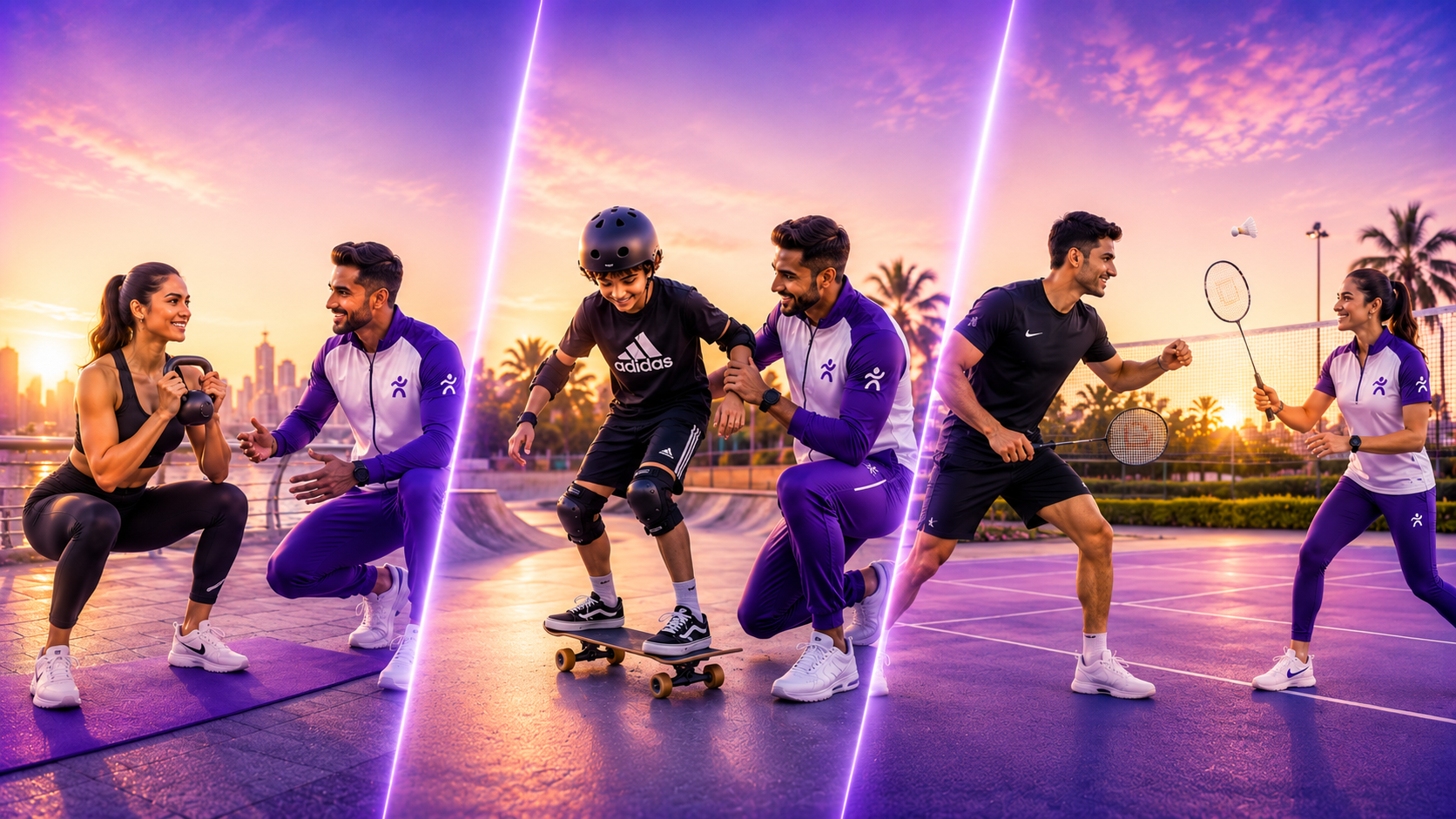
Stat 1: 94% of UAE residents want to be healthier — but aspiration alone is not the story
The most cited number from the GymNation 2026 report is striking: 94% of UAE respondents aspire to be healthier. That figure puts the UAE significantly ahead of the UK at 76% and the United States at 75% — a gap of nearly twenty percentage points on a metric that reflects not just attitude but cultural prioritisation of health.
The figure worth examining alongside it is 65% — the proportion of UAE residents who report their health actually improved compared to the previous year. That gap between aspiration (94%) and reported improvement (65%) represents the 29% of the market where intention exists but behaviour has not yet caught up. Understanding what is in that gap is where the more interesting data lives.
From Hey Trainer's membership base, that gap is predominantly a logistics problem rather than a motivation problem. Members who lapse rarely cite a loss of interest in fitness. They cite schedule disruption — a project deadline, a change in work hours, a school term beginning — that breaks the rhythm of their routine. When the format changes (gym visits become doorstep sessions), the same people maintain their schedule at significantly higher rates. The aspiration was always real. The friction was the variable.
Stat 2: 80% exercise at least twice a week — but frequency hides inconsistency
The GymNation 2026 data shows 80% of UAE fitness participants exercise at least twice per week, with 46% training four or more times weekly. Those are strong numbers by any global benchmark — the equivalent figures for the UK and US sit roughly 11 to 13 percentage points lower for the four-plus weekly category.
What the frequency data does not capture is the consistency of that activity across the calendar year. Hey Trainer member booking data shows a clear annual rhythm: session frequency peaks in September through November, remains strong through February and March, softens during Ramadan (the GymNation report finds 71% of UAE residents reduce exercise during Ramadan), and drops significantly between May and August as the heat eliminates outdoor activity and school holidays disrupt family routines.
For Dubai specifically, the effective training year is closer to seven months than twelve for most residents who rely on outdoor activity or fixed gym schedules. Doorstep sessions show a different pattern — they are more evenly distributed across the year because they adapt to climate and schedule rather than competing with them. The frequency headline is real. The consistency story is more seasonal.
Stat 3: 58% cite cost as the primary barrier to gym membership — and the implication is bigger than the number
The affordability finding in the GymNation 2026 report is the most structurally important number in the dataset: 58% of non-gym-goers cite cost as the primary reason they do not have a gym membership. That figure has worsened from 52% in 2025 — a six percentage point increase in a single year.
This appears, on the surface, to be in tension with the 43% of active fitness participants who increased their spending in 2026. The resolution is a two-speed market that is becoming more pronounced. Active fitness participants are spending more — on better coaching, on more sessions, on premium experiences that deliver measurable results. The lower end of the market is simultaneously becoming harder to access for people with genuine cost constraints.
For Hey Trainer, this dynamic shows up in package selection. The shift toward value-dense session bundles — packages that include equipment, nutrition support, and progress tracking alongside the coaching itself — reflects a client base that wants clear return on investment from their fitness spending. A session that includes a Premium Athlete Kit, nutrition timing, and tracked results justifies a higher per-session cost precisely because it eliminates the ancillary spending — gym membership, equipment, supplements, tracking apps — that accumulates around a less structured approach.
The affordability barrier is real. The response to it, for people who are already committed to their fitness, is not cheaper sessions — it is sessions where the value is unambiguous.
Stat 4: Gymtimidation affects half of Dubai's female fitness market
The GymNation 2026 report finds that gymtimidation — the feeling of anxiety, self-consciousness, or intimidation associated with gym environments — affects 50% of women and 35% of men in the UAE. While the male figure has improved by seven percentage points from 2025 (down from 42%), the female figure has reduced by only two points (from approximately 52%).
For a city with Dubai's fitness culture and infrastructure, 50% is a significant number. Half of the women who want to train are experiencing the shared gym environment as a barrier to confidence rather than a facilitator of it.
Among Hey Trainer's female members, this dynamic is one of the most consistently reported reasons for choosing doorstep coaching over a gym membership. The private session environment — at home, in a villa garden, in a building gym without strangers present — removes the performance dimension of public training entirely. There is no observation, no comparison, and no social pressure. The result, consistently, is clients who train harder, engage more honestly with their coaches, and progress faster than they did in shared environments.
The GymNation data also finds that 53% of UAE women prefer women-only fitness spaces, with 46% describing them as essential rather than merely preferable. The doorstep model naturally addresses both of these preferences — a female coach at a private location is by definition a women-only space — and Hey Trainer's coach network includes certified female trainers across all disciplines specifically to support this.
Stat 5: 51% of active gym-goers in 2026 are first-timers — the market is genuinely expanding
One of the most significant findings in the GymNation 2026 report is the proportion of members who had no prior gym membership before joining: 51%. This is not market share shifting between providers — it is new participation entering the market. The fitness industry in Dubai is genuinely growing its active user base rather than recirculating existing participants.
The first-timer statistic has a specific implication for how coaching needs to work in 2026. A new gym-goer who has never trained formally carries a particular set of needs: foundational technique, progressive challenge that does not overwhelm, a coaching relationship that builds confidence as much as fitness, and a format that does not require them to navigate a complex and unfamiliar environment while simultaneously learning new physical skills.
Group environments serve experienced users well. They serve first-timers significantly less well, for reasons that are structural rather than quality-related — the coach's attention is divided, the pace is set by the group average, and the self-consciousness of being new in a shared space compounds the challenge of learning.
One-to-one doorstep coaching, particularly for first-timers, removes every one of those barriers. The coach is entirely focused. The pace is exactly right. The environment is familiar. Among Hey Trainer members in their first programme, session completion rates are consistently higher than any group format equivalent — because the format is designed around the person rather than the other way around.
Stat 6: Strength training leads 2026 trend interest at 46% — and what Dubai's data adds
The GymNation 2026 report identifies strength training as the leading trend interest for the year at 46%, followed by HYROX at 29% and yoga and pilates at 28%. Strength training's position at the top of the preference hierarchy represents a cultural shift from a historically cardio-dominant fitness culture toward programming that builds long-term physical capacity.
Hey Trainer's booking data reflects this shift. Strength and conditioning sessions have grown as a proportion of total bookings over the past eighteen months, with functional strength — programming that builds capacity for daily life rather than purely aesthetic goals — growing faster than bodybuilding-focused programming. The profile of clients booking strength training has also broadened significantly: it is no longer predominantly male or age-skewed toward the 25-35 bracket. Women in their 30s and 40s, and clients over 50, now represent a fast-growing segment of doorstep strength coaching bookings in Dubai.
Yoga and pilates at 28% trend interest reflects a category that has expanded its audience significantly in Dubai — driven partly by the stress management narrative that has become central to wellness culture in the city. The GymNation data finds that 93% of UAE residents aspire to improve their mental health, and yoga's position as both a physical and psychological practice places it in a unique position in a market where the mind-body connection is now a primary purchase driver rather than a secondary consideration.
Stat 7: UAE leads the world on health aspiration — and what that means for the personal training market
The UAE's position at 94% health aspiration versus 76% in the UK and 75% in the US is not simply a cultural curiosity. It has a specific structural implication for the personal training market: when aspiration is nearly universal, the differentiating factor between markets is not whether people want to train — it is whether the available options make it easy for them to do so consistently.
The barriers in Dubai are well understood: traffic, heat, schedule compression, and the logistical complexity of a city where the gap between intention and execution is primarily a friction problem. The UAE's global lead on aspiration is not matched by a global lead on consistency — the same data shows that 41% of UAE residents do not meet the WHO's recommended weekly exercise guidelines. The aspiration is there. The structural support for converting it into consistent behaviour has been the gap.
Doorstep personal training is, in the most practical sense, a friction-reduction solution applied to a friction problem. It does not create the motivation — the aspiration data shows that is already present. It removes the logistical barriers that prevent that motivation from producing consistent behaviour. Hey Trainer's growth in 2026 reflects not the creation of new fitness demand but the capture of existing demand that was previously unable to find a format that matched how Dubai residents actually live.
Stat 8: 42% of UAE residents are regular wearable users — the data culture is real
The GymNation 2026 report finds that 42% of UAE residents are regular wearable users — significantly ahead of the KSA at 28% and comparable to or ahead of Western markets. This figure signals a Dubai fitness culture that is increasingly data-oriented: residents are already tracking their steps, heart rate, and sleep in significant numbers before they engage with a personal trainer.
For Hey Trainer, this creates a specific opportunity. Members who already use wearables arrive with baseline data — sleep patterns, resting heart rate trends, activity levels — that a coach can use to contextualise and design programming more precisely than a fitness assessment alone allows. The integration of app-based progress tracking across Hey Trainer's packages reflects the same data orientation: members who can see their own progression — skill milestones, body composition changes, session metrics — are more motivated, more consistent, and more likely to continue.
The data culture in Dubai's fitness market is not a future trend. It is the present reality, and the programmes, platforms, and coaches that work with it rather than around it are the ones producing the best results for their clients.
What the data tells us about Dubai fitness in 2026
Taken together, the picture that emerges from Hey Trainer's member data and the GymNation 2026 report is this: Dubai's fitness market in 2026 is characterized by high aspiration, genuine participation growth, real but specific barriers, and a clear shift toward formats that are data-informed, time-efficient, and accessible without a gym environment.
The residents who are succeeding in their fitness goals share a set of characteristics: they have found a format that fits their life rather than competing with it; they have a coaching relationship that provides accountability without pressure; they train in an environment where the focus is entirely on their progress; and they have a system — whether through wearables, app tracking, or regular assessment — that makes their results visible.
The residents who are not succeeding are, disproportionately, the ones for whom the friction of access — the commute, the fixed schedule, the shared environment, the cost of flexibility — has repeatedly interrupted the consistency that produces results.
Hey Trainer exists in the gap between those two groups. The aspiration is universal. The format is the variable.
Sources
- Hey Trainer member booking and session data, January–May 2026
- GymNation UAE & KSA Health and Fitness Report 2026 (15,322 respondents, January 2026)
- Dubai Fitness Challenge 2025 participant data (Dubai Department of Economy and Tourism)
- Dubai Active Industry 2025 UAE Health and Fitness Industry Report
Hey Trainer connects Dubai residents with certified personal trainers for doorstep sessions across boxing, strength training, yoga, martial arts, corporate wellness, kids' fitness, and more. Available on iOS and Android. Download the app today.
Recommended Packages

Aqua Elite: Swimming Mastery
Whether it's a child’s first splash or an adult refining their stroke technique, this package delivers personalized, high-yield coaching right to your pool. We match you with expert swim instructors to build water confidence, improve endurance, and master premium stroke mechanics.
AED 130 /session

Iron Core: Strength & Power
Build a foundation of raw power and functional strength. Our Iron Core program is engineered to increase bone density, improve joint stability, and develop peak physical force through expert-led resistance training delivered directly to your home.
AED 140 /session

Knockout Fitness: Elite Boxing
Unleash your inner warrior with a high-intensity boxing experience that blends explosive power, surgical precision, and elite conditioning. Whether you're looking to torch calories, master self-defense, or sharpen your mental focus, our expert coaches bring the ring to your doorstep. Transform your physique and your mindset—one punch at a time.
AED 150 /Session