
What a kids personal training session in Dubai looks like
Most parents picture a scaled-down adult session. What good kids' sports training in Dubai actually looks like is something entirely different and better

The question every parent has before booking
kids personal training session in Dubai actually looks like: Most parents who enquire about personal training for their child ask some version of the same question: what actually happens in the session? It is a fair thing to wonder. Personal training carries adult associations — heavy weights, intense cardio, a coach standing over someone with a clipboard. None of that translates to a ten-year-old, and parents are right to want to understand what they are booking before they commit.
The short answer is that a good kids' personal training session looks nothing like an adult one. The principles are the same — structured movement, progressive challenge, real coaching. The delivery is entirely different. And when the focus is sports performance, the session becomes something that most children find genuinely exciting rather than something they have to be dragged to.
Here is what it actually looks like.
Before the session starts
A good trainer does not arrive and immediately start the warm-up. The first session with a new child client begins with a short conversation — with the parent, and ideally with the child directly.
The trainer wants to know which sports the child plays or wants to play, what their current activity level is, whether there are any injuries or physical considerations, and what the child actually enjoys. That last point matters more than most parents expect. A child who is engaged and enjoying the process will work harder, retain more, and come back. A child who is going through the motions will plateau quickly regardless of how good the programming is.
In Dubai, this conversation often reveals a child who plays football at school and wants to be faster, or one who does swimming lessons and wants to improve their strength in the water, or one who has just started jiu-jitsu and wants to build the physical foundation to keep up with older training partners. Each of those starting points produces a completely different session structure.
The warm-up: where sports training actually begins
In a children's sports session, the warm-up is not a formality. It is where a significant amount of the real work happens.
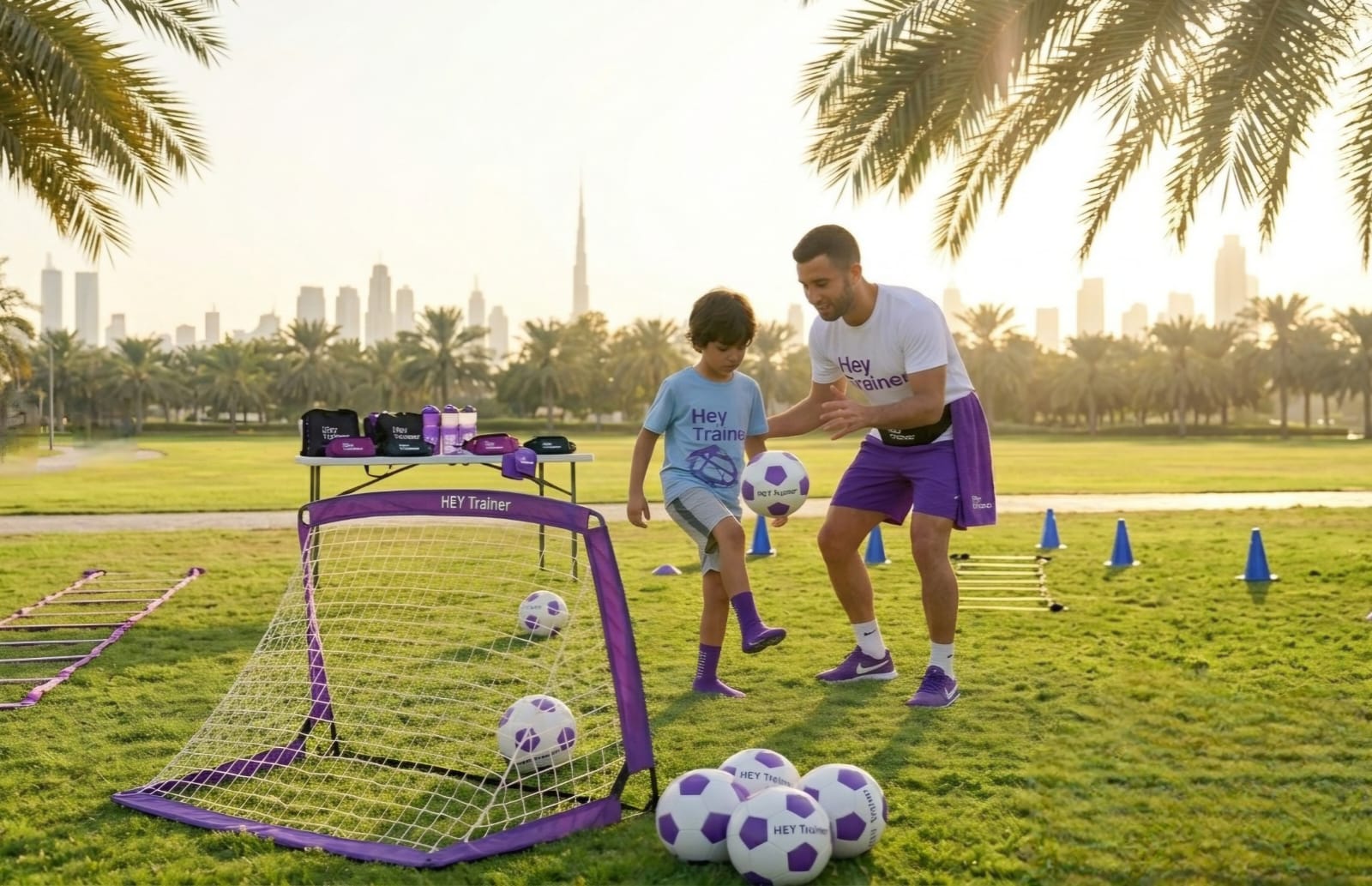
A well-designed warm-up for a young athlete builds coordination, agility, and movement awareness — the foundational physical literacy that underpins performance in every sport. Ladder drills, cone patterns, reaction games, and dynamic stretching are not just preparing the body for what comes next. They are developing the neurological pathways that make a child faster, more coordinated, and more spatially aware on a pitch, court, or mat.
For a child who is new to structured training, this part of the session alone delivers results that show up immediately in their sport. Parents who watch their child's football on weekends often notice the difference within a few weeks — better first touch, quicker reactions, cleaner movement patterns. That is the warm-up doing its job.
The main block: sport-specific work
This is where the session is shaped around the child's actual sporting goals. The structure varies significantly depending on the discipline, but the logic is consistent: identify the physical qualities that matter most in the child's sport, and build them progressively.
For a football player, that might mean explosive acceleration work, change of direction drills, and single-leg stability exercises that reduce injury risk and improve kicking mechanics. For a swimmer, it could be shoulder stability, core control, and hip mobility work that directly translates to efficiency in the water. For a young martial artist, the focus might be on rotational power, balance, and the kind of reactive agility that makes a difference in sparring.
None of this involves heavy weights for younger children. Bodyweight work, resistance bands, medicine balls, and agility equipment are the primary tools. The load is always appropriate to the child's age, developmental stage, and current capacity. The goal is never to exhaust — it is to build.
How a skilled trainer keeps a child engaged
This is the part that parents most underestimate before they see it. Working effectively with children requires a different skill set than working with adults. The technique knowledge is the same. The delivery is not.
A good youth trainer understands that children learn through play and competition, not through repetition alone. A drill becomes a game. A coordination exercise becomes a challenge with a target to beat. Rest periods involve conversation about the sport rather than silence. The session has a rhythm that keeps the child's attention without letting the energy drop.
Children who train with a coach who understands this dynamic do not need to be motivated to show up. They look forward to it. That consistency — showing up regularly because they want to, not because they have been told to — is the foundation of every meaningful physical result a child will achieve.
The cool-down and what it builds beyond fitness
A proper cool-down in a youth sports session is not just about the body. It is about the habit of reflection. A good trainer uses the last five to ten minutes to review what happened in the session, what improved, and what the focus will be next time. For a child, hearing specific, accurate feedback about their own progress — not generic praise, but real observation — builds self-awareness and a growth mindset that extends far beyond sport.
A child who finishes a session knowing that their left foot is now more consistent than it was two weeks ago, or that their reaction time on the agility ladder has measurably improved, leaves with something that a group class almost never provides: a clear, personal picture of their own development.
What parents typically notice first
The physical changes take time, as they should. What parents usually notice first, often within the first three or four sessions, is a shift in how their child talks about sport and physical activity. They become more curious about their own performance. They practice at home without being prompted. They ask questions about technique that they were not asking before.
That shift in attitude is the most durable result of good one-to-one sports coaching. It is also the hardest thing to manufacture in a group environment, where the coach's attention is divided and the child's individual progress is difficult to track.
Booking a sports session for your child in Dubai
Hey Trainer connects Dubai families with certified coaches for doorstep sports training sessions covering football, swimming performance, martial arts, general athletics, and more. Sessions are delivered at your home, building gym, or outdoor space — on a schedule that fits around school and family commitments rather than a fixed class timetable.
Parents can browse coach profiles by discipline, read about their experience working with children, and book a single trial session before committing to anything further. The first session is the best way to see whether the format, the coach, and the child are the right fit.
Most parents who watch their child's first session are surprised by how much it looks like exactly what their child needed.
Hey Trainer connects Dubai families with certified personal trainers for doorstep sports sessions and more. Download the app and book your child's first session today.
Recommended Packages

All-Star Trio: Multi-Sport Discovery
Unlock your child's athletic potential with the rotation of speed, skill, and balance with our ultimate variety pack. The Triple Threat allows young athletes to explore three iconic sports: Football, Skateboarding, and Basketball in a low-pressure, high-fun environment. It’s the perfect way for helping young athletes sharpen their coordination and discover new talents across three distinct disciplines.
AED 130 /Session

Build Football Skills
Master the pitch with a program tailored for any age. Whether a child building fundamentals or an adult refining match-day tactics, our Total Baller package focuses on pro level finishing, creative dribbling, and precision passing.
AED 100 /session

Cycling Mastery Training
From first-time balance to advanced road safety, our expert coaches guide your child every step of the way. We build the stamina, coordination, and confidence they need to explore the world on two wheels.
AED 90 /Session